Urban Hedge Witch
City Magic, Parking Lots as Mystic Thresholds, & Rose Mysteries
Before I share what’s been going on lately, a few introductory thoughts:
What is a Hedge Witch?
In Britain, hedges between properties are considered liminal spaces—potent realms suited to magic spells. A Hedge Witch is a magical practitioner who takes advantage of such powerful spaces to do rites.
You can think of hedges not only as as thresholds between properties but also as thresholds between the mundane and mystic planes.
A Hedge Witch is a shaman who often walks between the worlds regardless of whether a physical hedge is nearby.
Liminal spaces also provide thresholds through which we can enter into a new life, such as a transition from poverty into financial well-being or from lack of self-esteem into self-confidence.
I Love and Hate the Term Hedge Witch
When I first heard the term Hedge Witch, I was delighted. It evokes magical green depths, mysterious going-ons, and fantastical activities. However, I hate the way the term is often used nowadays aka I am a Hedge Witch. I am not like other Witches. I’m better than other Witches.
When we define ourselves by our differences, ignoring our commonalities, we strangle ourselves with categories. Definitions like Hedge Witch, Fairy Witch, and Green Witch can be wonderful when they help us find and affirm who we are magically. But they tend currently to be used divisively and arrogantly, neither of which helps magic work well.
And—I’m only talking for myself—the divisions don’t make complete sense for me because I’m a Hedge Witch, Fairy Witch, Green Witch, Shamanic Witch, and other types of Witches. They are all part and parcel of Witchcraft as I know it. I cannot be one type without being the other types. In fact, in my case, shamanism and Witchcraft are synonymous, as they were traditionally in Europe.
Again, only speaking for my Witchcraft: I need phrases like Kitchen Witch, Hedge Witch, or Solitary Witch because they each invoke a special magic that I want. They are lyric—not definitive—terms. Were I to use them as strict categories, they become cages that trap my spirit and my magic.
What is an Urban Hedge Witch?
Urban Hedge Witch is a term I made up. In the spirit of what I’ve said above, I don’t want to give Urban Hedge Witch a definitive meaning. Rather than provide a glib category, I prefer to let you read this post.
End of introductory thoughts.
A Happiness and Prosperity Ritual Using Rose Petals
I am having the best time! A friend sent me boxes of fresh rose petals.
We were on the phone, and I told her I wanted to strewn petals throughout my new apartment and, still on the phone with her, I looked up how to buy fresh rose petals online. I was stunned by the cost. My friend generously offered to buy the petals.
I’m becoming an urban shaman again after almost two decades of living in the woods. The rose petals became part and parcel of my return to city magic.
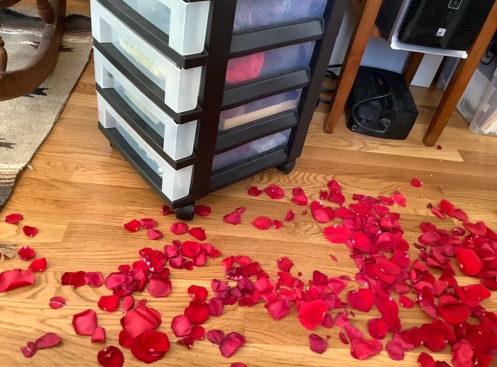
The petals strewn all over the floor are just a third of what my friend sent!
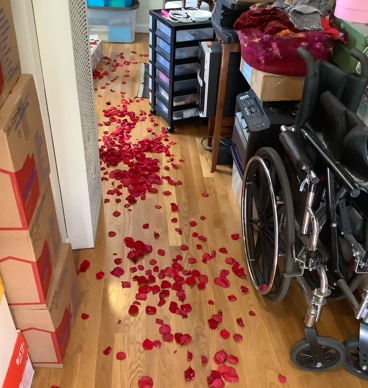
That same third is swept up against the door, waiting to be used again in the ritual:
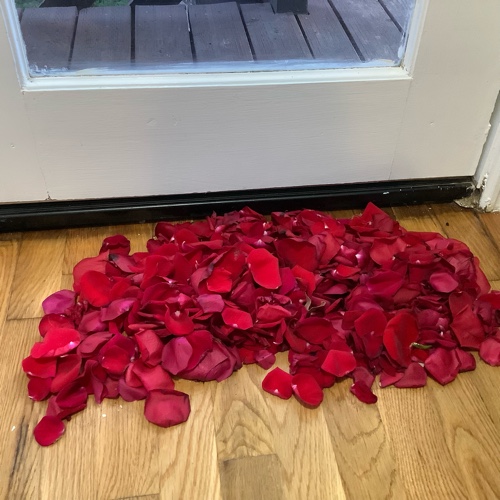
I decided not to dump all the petals on the floor. I loved the amount that I dumped.
I’ve been walking through it, sweeping it up as a ritual for happiness and prosperity. Later, I re-scattered the petals I swept up, strewn them all over the floor again, to finish the ritual. (I’m not giving complete details of the ritual I channeled because I want to move on with the post, but here’s lots of Rose Magic info: https://stardrenched.com/2020/11/24/rose-magic/.)
And then there’s a great big container that I dumped the rest of the petals in. I put my phone next to it for scale. So many petals!
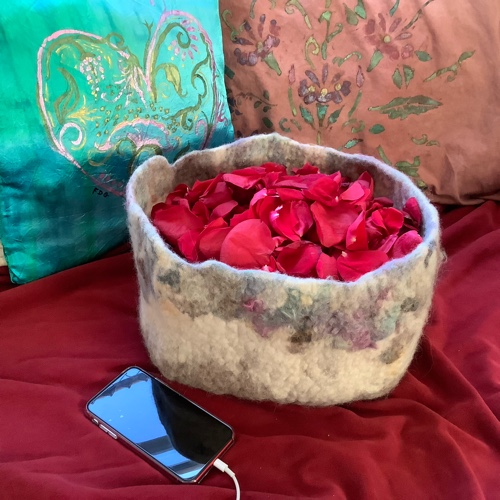
The rose petals were part of returning to urban shamanism not only because I used them in a housewarming rite but also because they were a gift from a friend. Generosity is pure magic.
The Right to Love Life and Live My Dreams
I’ve been running my fingers through the container’s rose petals, loving the licentiousness of so many petals against my skin and how it gives me permission to love life and go for broke. I also crush them in my hands for the sheer visceral pleasure of organic matter in my palms when I’m no longer in the country but in the middle of the gray dusty city.
Ritual Is as Inherent to Living as Breathing Is
My new apartment is tiny. After I moved in, it was wall-to-wall boxes. It kind of still was after only a week and a half here, though it was much better already.
I almost asked my friend to wait, not send me petals until a lot of my boxes were unpacked. I thought gobs of strewn vegetation might be a big mess, what with the crowded space.
Then I realized I should relish the roses whenever they came, and if they arrived soon, they would be a beautiful tool to bless my unpacking and other nesting.
I try to practice what I preach, and I teach to not wait until the “right” time to do a ritual, for example not wait until you are focused, or until you know what you want to get out of the ritual. Ritual is part of life, as inherent to living as is breathing, it was as much a part of the first humans’ life as was hunting.
Thresholds Can Appear Any Time, Any Place
The time when I’m not fully unpacked is betwixt and between; it is a threshold, which makes it a liminal space, a realm in which all possibilities can come forward for my choosing.
This is a perfect opportunity for rose magic. Rose is a symbol of the deepest Mysteries. Sometimes, they are more easily touched when circumstances are new or uncertain.
Plus Mysteries transcend time and space, so are always available to us, whether we’re in the country, the city, the suburbs …
Thresholds can open anytime, anywhere. I can be a hedge Witch anywhere, anytime. Someday, perhaps I’ll open the wardrobe that peeks into Narnia. That door can appear if I watch for it, continue to believe in magic, and ever-acknowledge that life’s problems are constant opportunities for spiritual growth—thresholds, for example, from self-obsession to self-care, from fear-induced stagnation to self-expression, or from resentments to emotional freedom.
To play with rose petals when there was unpacking I might have been doing was gloriously foolish and magically potent.
For one thing, it distracted me from the studio being filled with boxes, and from my being knee-deep in the chaos of constantly figuring out this new dwelling’s basics—where is the light switch I need right now, how do I buzz the person in who is trying to deliver a package, oops there’s no longer a door to my right, a wall is there now. My focus instead shifted to the eternal, the joyful, the potential for all I want to be manifested.
I’m an urban shaman again, using the magic that’s here, and the rose petal ritual was part of my reentry into that.
Urban shamanism was crucial to me till I moved to the country 17 years ago. My book, Be a Goddess!, originally had a passage about city magic. It was taken out, right before the book went to press. We needed to cut page count, and the section wasn’t pivotal to the lessons in the book. But I hated to delete that section. Remembering how crucial it was is important because it affirms my connection to the song I hear from sidewalks.
Urban Hedge Witch at Goddess Diana’s TriVia—Three Roads
In the city, I tend to rent places on the margins between two parts of town. It happens without my trying. I simply find an apartment I like, and it’s betwixt and between.
Now I’m living on the exact border between Duboce Triangle and the Mission District. I am the urban equivalent of a Hedge Witch, a shaman dwelling in liminal city spaces, living at a threshold.
There are actually three realities that my building borders because the Castro is so near that, as soon as I go out, I’m walking alongside members of the LGBTQ+ community.
I am at my Goddess Diana’s archetypal trivia—three roads. (See Roman Religion and the Cult of Diana at Aricia by C.M.C. Green for more information. Or click here: https://stardrenched.com/2020/03/25/dianas-crossroads-during-the-pandemic/ )
The junction of three roads in the wilderness, another liminal space.
All of San Francisco Is Betwixt and Between
The geological features beneath San Francisco are, for me, congruent with the definition of liminal spaces. The earth under the sidewalks enlivens them until they speak to me. I wouldn’t be surprised if a lot of serpentine stone—California’s State Rock—hides below this city. Serpentine, unassuming, yet rich with secrets.
When I first returned to San Francisco, I stayed at a friend’s place for a few months in a posh area—Nob Hill.
I opened my friend’s front door one day, prepared to walk down the steps to go on an errand. But two fellows sat on the front stoop, clearly setting up for a “transaction.” When they saw me, they immediately stood but instead of walking off as I expected, they ambled only a few feet away. Then one of these shady-looking fellows leaned against a car, while his companion relaxed nonchalantly against a tree. There, they continued to prepare for commerce.
This was not an unusual occurrence. All of San Francisco is liminal, betwixt and between.
Greed’s Heartless Threshold between Wealth and Poverty
San Francisco has a merciless border—a thin transparent line between wealth and a poverty reminiscent of my worst nightmares, ones that woke me up in terror and left a foreboding I could not blithely shake.
There’s no San Francisco street where you will not see someone unsheltered. It terrifies me: the American attitude of “I want it all so will ensure very little is left for anyone else” is starkly revealed in San Francisco, and that American greedy norm could easily catapult me into poverty, as it could anyone, even someone wealthy.
I am also petrified by the fact that, were I to take a financial spill, the threshold through which one might travel from poverty to financial well-being is often impermeable. So I try not to morbidly focus on it.
Instead, I strive to acknowledge the possibility of deprivation as an ongoing fact of life, and I choose to participate in life. I must view my enormous fear and the possibility of destitution as thresholds for spiritual growth. I must face this fear yet leave it behind me. None of this is easy for someone who has known deprivation. But I have no choice. Fear will destroy the song in my soul.
I must also remember magic removes barriers (though my fear would tell me otherwise and can be hard to shake off) and take life’s ever-present possibility of pauperization as a threshold in which magic abounds—enchantment that I can embrace as a tool to, among other things, manifest prosperity.
Magic is miracle, so I can let go of the self-defeating belief “The deck is stacked. Success is impossible” and replace it with “All goodness is possible. All thresholds into plenty are possible to traverse.”
My Home in the Hedges
All San Francisco residents are liminal dwellers, but this current apartment stands at so many crossroads and borders, more than I’ve already mentioned. For example, the range of incomes demonstrated by the homes on my one block is remarkably wide. And then there’s the large parking lot by my building.
The lot accommodates a few businesses—a Fed Ex, a pet supply store, and a law office. The lot is a beehive of wildly disparate activity all day, ranging from elderly individuals carrying packages (usually well-off elders, or so their vehicles would imply), to truck drivers who I suspect are long-haulers taking a break, to drug dealers, to teenagers whose cars blare loud tunes, to elegant young gay couples with their dogs.
Unsheltered individuals go to and from the parking lot, as they do throughout San Francisco, though the proprietor of one of the stores makes sure no one sets up camp there.
One day, I looked out to see a homeless man whack back all the overgrowth that had come through the lot’s back fence. I don’t know why he did that. Did the owner of the parking lot hire him? A huge pile of cut-down brush is there now, weeks later. I don’t think it’s all from that one incident. I’m surprised no one’s taken it to build shelter.
Another day, I looked out and, in the corner of the parking lot right below my kitchen window, a homeless man performed obsessive and compulsive movement patterns for about ten minutes. … Well, I’m not sure he did it the whole 10 minutes since I walked away from the window and returned only briefly to peek surreptitiously.
Last week, I happened to notice a woman in the same spot below my kitchen window. As I said, it is not only homeless people who come to that parking lot but San Francisco residents of all kinds, constantly. Beautifully dressed and sharply focused, she was exiting her car. Then she placed a small rug on the ground. After removing her shoes, she stepped on the rug and knelt for, perhaps, Islamic prayer. I backed away from the window, not wanting to disturb her worship. I returned to the window moments later to see her put her shoes back on, pick up her rug, get in her car, and drive away.
This week, a man appeared in the same spot, with his own car, prayer rug, and fulfillment of sacred obligations. Like the woman who had been praying, he appeared to be well-off.
That spot below my window is the parking lot’s most recessed corner, so has become a haven for city dwellers.
How could a parking lot not be a mystic threshold, with the constant comings and goings and potential for anything to occur?
My Home Is in My Heart
I think the Old Gods sent me to this apartment to grow spiritually, become more prosperous than ever, indulge in glorious Mysteries, hone my urban shamanism, and dwell in my full power during my elderly years (I turn 73 this fall).
I may not remain in this apartment for more than a year. It might be a transition. Yet another liminal space.
But my home is in my soul and in care from my Gods, including Gaia and Mother California.
I do not feel rooted into this apartment. I feel rooted into the land beneath it. This plot of earth loves me. As did stony Nob Hill when I briefly lived there.
My roots extend deep. My roots extend wide throughout the West Coast. Uprooting myself to move to Pennsylvania was awful and unsuccessful. I felt like my legs had been cut off, my roots still here. In my 18 years in Pennsylvania, there wasn’t a day I didn’t miss being here.
Children Understand Magic and Liminal Spaces
I grab a huge bunch of rose petals. It is a small amount compared to the exuberant quantity in the container. I drop the bunch back in, I repeat this—grab and drop, over and over, the feel of the petals in my hand, then I squeeze the red velvet as it heals my weary eyes, squeeze, drop, squeeze, drop, then press my face hard against the vegetative red.
One of my favorite childhood memories appears—my father clipped the hedges (oh my, hedges, I never made that connection until right this second) then put the clippings into a huge barrel, after which I found a long something, stick he had chopped from the hedge? Shovel? and I used it to stir the clippings, stir the leaves, pretending to be a Witch, one of my favorite childhood memories, my young heart delighted by the fancy.
The delight made child-me as big as a fairy tale.
All my rose play now and the memory remind my belly and soul that anything is possible; I have all the power I need to achieve what I want.
Taming the Wild? I won’t Let That Happen!
My father, who was a terrible man, burnt down my mother’s rosebushes. (Roses! Everything is connecting. Mom’s beautiful womanly magic in the backyard.)
When he cut the hedges, he must have been trying to tame them, sculpting them into typical bourgeois rectangles. I suspect my child self felt, deep down unbeknownst to herself, that she was rescuing that liminal space, freeing it to be wild again.
I have all the power I need to achieve what I want.
So mote it be! Thank you, thank you, my Gods, my California, and my friend who sent me rose petals!









 In the old Italian religion, the Magna Mater—Great Mother Goddess, Creator of All—was known as Diana. Italian lore reveals Diana to also be the Queen of Fairies.
 “When I talk about shunning greatness, I’m referring to a very specific dilemma. I need to push everything far past what I’ve ever done. There is no escape anymore, except fully into Her will all the time and into the pleasure of Her embrace, not as escapism but as a simultaneous retreat from the world and utter integration with humankind’s plebeian existence. To fully find my Fey self in a new way. I run from that constantly. Makes me miserable. . . .


 These skinny ladies in old tales usually stayed bone thin despite dining on children and disgustingly extravagant banquets. Perhaps she represented elderly women actually struggling without much to eat, the mischaracterization meant to provide the justification to rob them regardless. In other words, if an elderly woman was resented for eating any amount of food, then misrepresenting her reasonable or insufficient meals as gluttony provided an excuse to “righteously” rob her—greedy witch! She did not deserve food and its source—land and livestock.

 The right to pursue happiness—joy—includes the right to land or a comparable means to material well-being, such as a reasonable wage instead of employers earning far more than is even decent while employees can’t make ends meet.
 I decided to eat grains again. That might seem ridiculous, given that serious symptoms were abating so readily. But I don’t want to deprive myself of my “daily bread“ longterm only to find that I ignored the spiritual solution that would’ve been the longterm fix. Ignoring the source of the problem will simply make it manifest in another way, sooner or later.
 I myself have had to make peace with awful ancestors. For one thing, I don’t want hate in my heart. I can no longer bear the damage it does me.
 Another common question is how to deal with ancestors if you’re adopted. There are so many questions when it comes to that, including one relevant to this post: making peace with an abusive adoptive parent who has passed on, or with their ancestors.
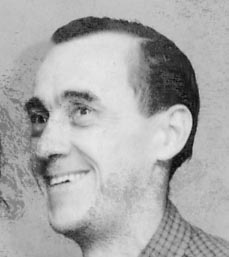
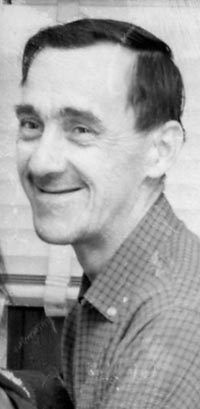
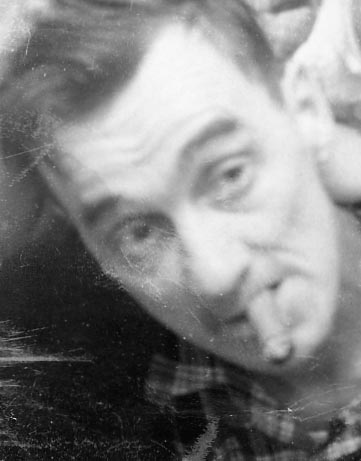 My father was always on the outside looking in. And he loved music beyond all reason.
 When I was 14, I asked him and Mom if I could start going to folk music clubs. These were clubs for adults, and were not in my neighborhood. They were in downtown Boston and Cambridge.
 Though it’s geared to inflate his false ego, I’m happy today to tell his spirit, wherever he is, “Dad, look, look where my name is. Next to Johnny Cash’s.” And, “Dad, I never mentioned it before. My album with the song about you on it? It was a bestseller. And that book I told you I was writing, right before you died? Bestseller and dedicated to you.”
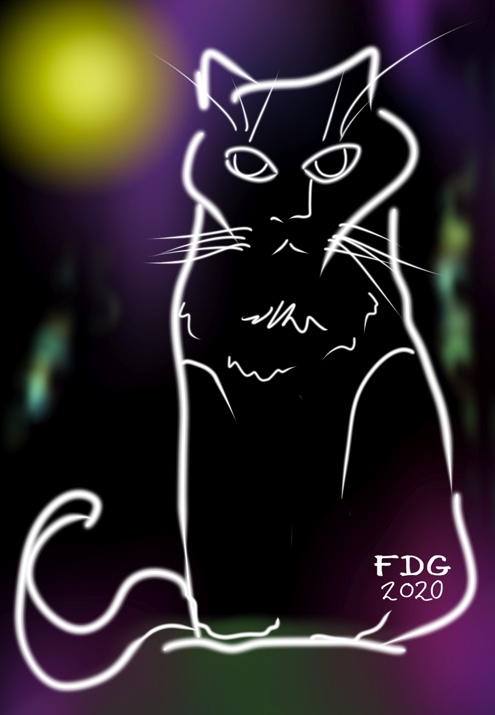
 In the ‘80s, I saw so many images of the house cat version of Bast having a gold, hoop earring piercing one of Her ears, that I assumed it was traditional. Then, I researched to see if the gold hoop is a modern addition, but couldn’t find the answer.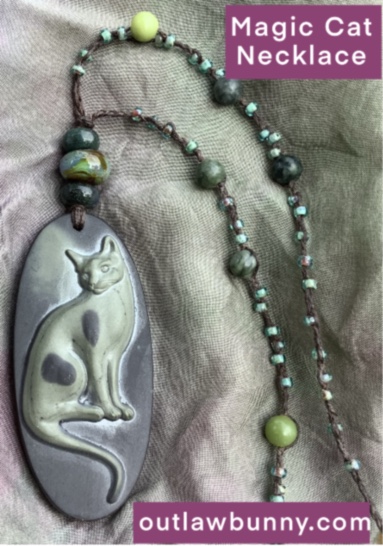
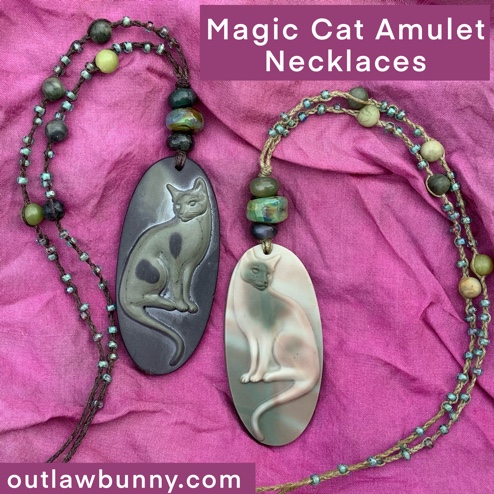
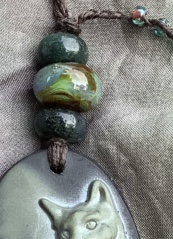 The largest of the three beads is a focal lampwork bead. I go to great lengths to acquire items that help make each of my talismans shines with both its own unique beauty and singular magic. I buy beads carefully, taking my time. The lampwork beads in these two talismans are two of 18 unique beads I commissioned from Jill at